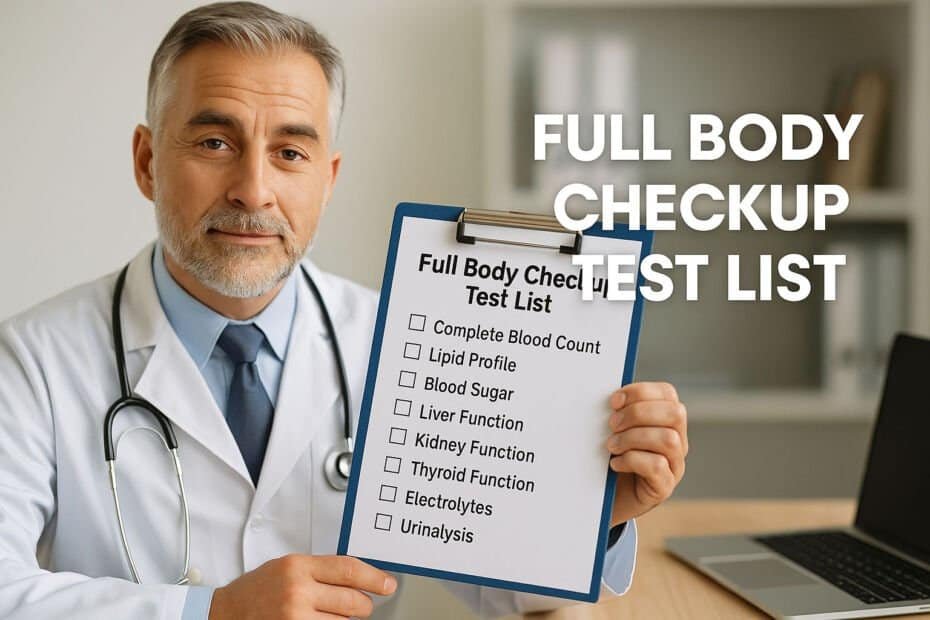
This blog explains what a full body checkup is, why it matters, how to choose the right package, typical price bands, reputable providers in India, and, most importantly, the actual profiles and tests commonly included in basic, standard, advanced, and master-level wellness packages. Use it to pick a package that matches your age, lifestyle, and medical history (not just the biggest “test count”).
This content is intended for general educational purposes only. Laboratory screening does not replace medical diagnosis or treatment. Test results must be interpreted by a qualified healthcare professional in the context of medical history, symptoms, and physical examination.
- Meaning of Full Body Checkup
- Importance & Who Should Consider
- Blood & Urine Profiles Typically Covered
- Types of Packages (Basic to Master)
- How to Choose the Right Package
- Prices & What Affects Cost
- Service Providers in India
- Complete List of Tests (Master-level)
- Standard Package: Typical Test List
- FAQs
What is a Full Body Checkup Package?
A full body checkup (also called a preventive health checkup) is a pre-planned bundle of blood and urine tests used to screen your overall health. Instead of ordering tests one-by-one, a bundled package brings together essential profiles (liver, kidney, lipid, diabetes markers, thyroid, vitamins, etc.) to flag risks early and guide follow-up with your clinician.
Why consider a preventive full body checkup?
Screening may help identify abnormal values early and support timely clinical evaluation. Periodic screening is useful for adults with a family history of metabolic conditions, sedentary jobs, stress, irregular sleep, weight changes, or prior lab abnormalities. You can always interpret results with a qualified clinician.
What profiles does a package usually include?
Most packages are built from these core profiles (linked pages explain each): Thyroid, Diabetes, Cardiac risk markers, Lipid profile, Liver (LFT), Kidney (KFT), Complete hemogram, Vitamins, Elements & metals, Metabolic, and urine analysis. Advanced bundles may add autoimmune, inflammatory, and specialised markers based on medical advice.
Types of full body checkup packages
- Basic wellness – Core screening (Lipid, LFT, KFT, Thyroid, CBC, Urine, basic glucose). Good for first-time screening or annual baseline.
- Standard wellness – Basic + diabetes panel (HbA1c), extended lipids, and 1 to 2 vitamins (B12, D). Often considered for adults without known medical conditions, based on individual risk assessment.
- Advanced wellness – Standard + cardiac risk markers, complete vitamin panel, iron studies, urine microalbumin, and extended elements/metabolic profile. Can be considered for individuals with metabolic risk indicators, depending on the clinical context.
- Master/executive wellness – Comprehensive multi-profile screening with expanded inflammatory/autoimmune/metals and additional risk markers. Should be selected in consultation with a healthcare professional when clinically appropriate.
How to choose the right package (don’t chase “test count”)
- Start with your context: age, symptoms, medical/family history, medications, and prior lab reports.
- Prioritise relevance over volume: a focused standard/advanced package with the right biomarkers is better than a larger bundle of low-value add-ons.
- Match to goals: general screening – Standard; lifestyle/metabolic risks – Advanced; complex history or clinician-led review – Master.
- Plan follow-up: discuss abnormal results with a doctor; don’t self-diagnose or alter medication without advice.
Complete list of tests in a master-level package
Master/executive bundles generally include 120 to140 parameters. A representative list is below (exact composition can vary by brand and update cycle):
Iron Deficiency Profile (5)
- % Transferrin Saturation
- Iron
- Ferritin
- Total Iron Binding Capacity (TIBC)
- Unsaturated Iron Binding Capacity (UIBC)
Liver Function (12)
- Serum Alb/Globulin Ratio
- Alkaline Phosphatase
- Bilirubin – Direct
- Bilirubin – Indirect
- Bilirubin – Total
- Gamma-GT (GGT)
- Protein – Total
- Albumin – Serum
- Serum Globulin
- AST (SGOT)
- ALT (SGPT)
- SGPT/SGOT Ratio
Cardiac Risk Markers (7)
- Apo B / Apo A1 Ratio
- Apolipoprotein A1
- Apolipoprotein B
- Homocysteine
- High-sensitivity C-reactive protein (hs-CRP)
- Lipoprotein(a) [Lp(a)]
- LP-PLA2
Complete Hemogram (30)
- Basophils – Absolute
- Eosinophils – Absolute
- Lymphocytes – Absolute
- Monocytes – Absolute
- Neutrophils – Absolute
- Basophils %
- Eosinophils %
- Hemoglobin
- Immature Granulocytes (IG)
- IG %
- Total Leucocyte Count
- Lymphocyte %
- MCH
- MCHC
- MCV
- Monocytes %
- Neutrophils %
- Nucleated RBC
- Nucleated RBC %
- Hematocrit (PCV)
- Platelet Count
- Total RBC
- RDW-CV
- RDW-SD
- PDW
- MPV
- P-LCR
- PCT
- ESR
- Reticulocyte parameters (as applicable)
Toxic & Essential Elements (22)
Typical multi-element screens quantify exposure to aluminium, arsenic, cadmium, chromium, lead, mercury, nickel, barium, beryllium, cobalt, molybdenum, antimony, selenium, tin, strontium, thallium, uranium, vanadium and others; some panels also report copper and zinc (see “Elements” below).
Urinalysis (10)
- Specific Gravity
- Bilirubin
- Blood
- Urobilinogen
- Glucose
- Ketone
- Leukocyte Esterase
- Nitrite
- pH
- Protein
Vitamins (12)
- Vitamin D (Total)
- Vitamin A
- Vitamin B12
- Vitamin B1 (Thiamine)
- Vitamin B2 (Riboflavin)
- Vitamin B3 (Niacin)
- Vitamin B5 (Pantothenic)
- Vitamin B6 (PLP)
- Vitamin B7 (Biotin)
- Vitamin B9 (Folic Acid)
- Vitamin E
- Vitamin K
Kidney Function (10)
- BUN / Creatinine Ratio
- Blood Urea Nitrogen (BUN)
- Calcium
- Creatinine – Serum
- Uric Acid
- Creatinine – Urine
- Urine Albumin/Creatinine Ratio (UACR)
- Urea
- eGFR
- Urea/Creatinine Ratio
Lipid Profile (10)
- Total Cholesterol
- HDL Cholesterol (Direct)
- LDL Cholesterol (Direct)
- LDL/HDL Ratio
- HDL/LDL Ratio
- HDL-Non-HDL Ratio
- Non-HDL Cholesterol
- TC/HDL Ratio
- Triglycerides
- VLDL Cholesterol
Thyroid Profile (3)
- Total Triiodothyronine (T3)
- Total Thyroxine (T4)
- Thyroid-Stimulating Hormone (TSH/US-TSH)
Diabetes Panel (7)
- Average Blood Glucose (ABG)
- Blood Ketone (D3HB)
- Fructosamine
- HbA1c
- Fasting Plasma Glucose
- Urine Microalbumin
- Fasting Insulin (if clinically indicated)
Pancreatic Enzymes (2)
- Amylase
- Lipase
Electrolytes (2)
- Chloride
- Sodium
Elements (2)
- Serum Copper
- Serum Zinc
Inflammation/Metabolic (select)
- ESR
- Magnesium
Note: Some master bundles add autoimmune markers (e.g., ANA, anti-CCP, etc.) based on clinical context. Ordering should follow the physician’s advice.
Standard health checkup: 90 to 95 tests
A standard bundle usually includes the following:
Lipid Profile – 8
- Total Cholesterol
- HDL (Direct)
- LDL (Direct)
- LDL/HDL Ratio
- Non-HDL Cholesterol
- TC/HDL Ratio
- Triglycerides
- VLDL
Thyroid – 3
- T3
- T4
- TSH
Diabetes – 3
- Average Blood Glucose (ABG)
- HbA1c
- Fasting Plasma Glucose
Liver Function – 12
- Serum Alb/Globulin Ratio
- Alkaline Phosphatase
- Bilirubin – Direct
- Bilirubin – Indirect
- Bilirubin – Total
- GGT
- Protein – Total
- Albumin – Serum
- Serum Globulin
- AST (SGOT)
- ALT (SGPT)
- AST/ALT Ratio
Kidney Function – 8
- BUN/Creatinine Ratio
- Blood Urea Nitrogen (BUN)
- Calcium
- Creatinine – Serum
- Uric Acid
- Urea
- eGFR
- Urea/Creatinine Ratio
Vitamins – 2
- Vitamin D (Total)
- Vitamin B12
Essentials & Urine – 45 to 50
- Complete Hemogram (30 parameters)
- Urine Routine (10–24 parameters depending on strip/method)
- Iron
- Chloride
- Sodium
- Calcium
FAQs
How often should a full body checkup be done?
The appropriate frequency depends on age, medical history, family history, and existing risk factors. A healthcare professional can advise an interval suited to individual circumstances.
Does a higher test count mean a better package?
Not necessarily. Clinical relevance is more important than total test count. Screening panels should align with medical context rather than marketing size.
Should I choose Master-level packages for better safety?
Advanced panels should be selected when clinically appropriate. Ordering extensive panels without medical indication may not improve health outcomes.
Can these tests diagnose disease?
Screening panels identify abnormal laboratory values. Diagnosis typically requires clinical examination and, when necessary, additional testing.
Prices: Current Trend
In India, offer prices for full body checkups typically range from ₹799 to ₹9,000, depending on brand, city, logistics (home sample vs. walk-in), and the specific tests included (advanced cardiac markers and comprehensive vitamin/element panels increase cost). MRP is usually higher than limited-time offers.
Tip: focus on medical suitability and quality controls (NABL/CAP-aligned processes) rather than the biggest “test count.”
About the Author
Hema Mehta Sahoo is a clinical laboratory expert and the Center-in-Charge for three Thyrocare branches in Jamshedpur. With a background from Delhi University and a primary focus on pathology, she combines real-world diagnostic experience with editorial leadership to provide authoritative, evidence-based healthcare content.
Medical Review
This article has been reviewed for medical accuracy by: Dr. M. A. Khan, MD (Pathology)
Dr. Khan reviews laboratory terminology, test descriptions, and safety guidance related to diagnostic screening. This review does not establish a doctor–patient relationship.