
PRL Hormone Test for Fertility and Pituitary Evaluation
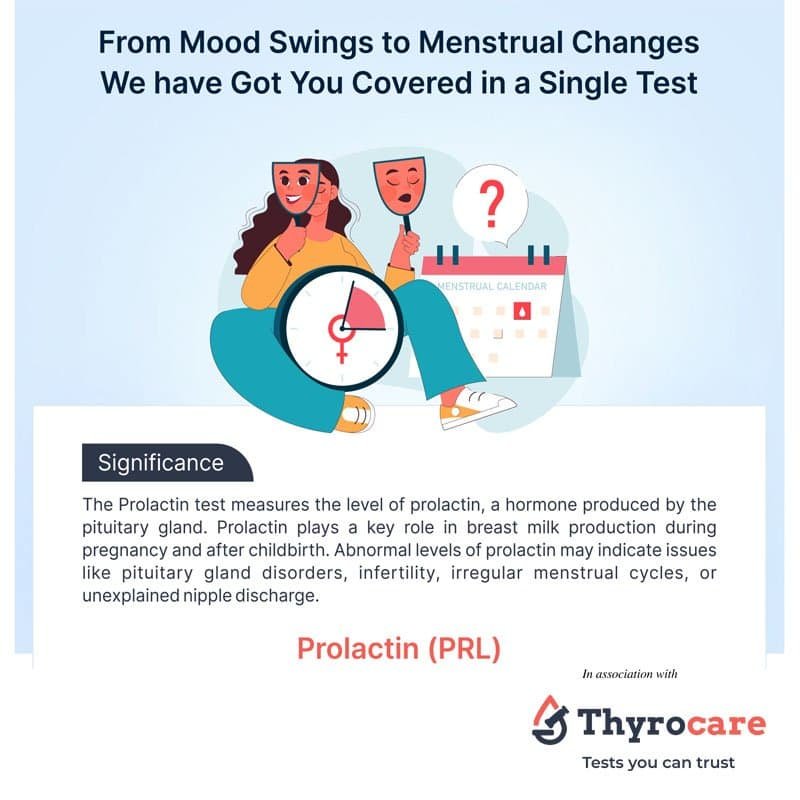
Book Thyrocare’s Prolactin (PRL) blood test across India. This hormone test evaluates pituitary gland function and is primarily used to investigate the causes of irregular menstrual periods, unexplained breast milk production (galactorrhea), infertility in women, and low libido or erectile dysfunction in men.
Book Securely via WhatsApp, Pay During Sample Collection
Prolactin (PRL) Blood Test: Quick Facts
| Also Known As | Luteotropic Hormone Test, Luteotropin Test. |
| Offer Price | ₹499 |
| Discount Applied | ₹201 on MRP |
| Sample Type | Blood (Serum) |
| Fasting | Not required for standalone PRL testing; morning sample collection is preferred |
| Testing Lab | Thyrocare (NABL Accredited) |
| Clinical Use | Evaluating menstrual irregularities, infertility, unexplained breast milk production (galactorrhea), pituitary gland function, and low libido. |
| Reporting Time | 12 to 24 hours after sample collection |
| Service Type | Free home sample collection (in 2,500+ PIN code areas across India). |
Test Preparation & Timing
- Fasting: Fasting is not required. However, many endocrinologists prefer the sample to be taken in the morning (about 3 to 4 hours after waking up) when prolactin levels are most stable.
- Activity: Avoid strenuous physical exercise and high-stress situations on the morning of the test, as these can artificially inflate prolactin levels.
- Clinician Instructions: Always follow any specific timing, fasting, or medication-withholding instructions provided directly by your treating doctor.
Laboratory Process & Booking
- Sample Collection: A Thyrocare phlebotomist will arrive at your scheduled time to draw a venous blood sample at your home or office.
- The sample is analyzed using fully automated CLIA (Chemiluminescence Immunoassay) technology on a bidirectionally interfaced laboratory system for numerical hormone quantification.
- Booking: Message +91 70701 77147 on WhatsApp with your name, PIN code, and preferred time slot. We will confirm Thyrocare’s availability in your area and secure your booking. Reports are delivered digitally in 12–24 hours.
Sample Report: PRL Blood Test
Open the sample PDF to understand the standard format of a Thyrocare PRL test report. It shows how the CLIA-processed numerical value is mapped against age and gender-specific reference intervals.
Test Specifications (PRL by CLIA)
| Specification | Details |
|---|---|
| Test Name | Prolactin (PRL) |
| Laboratory Method | CLIA (Chemiluminescence Immunoassay) |
| Measured Marker | Prolactin hormone reported numerically in ng/mL |
| Sample Requirement | Venous blood drawn into a standard serum separator tube |
Note: Prolactin is rarely evaluated in isolation when diagnosing complex fertility or menstrual issues. If your doctor has prescribed PRL alongside TSH, LH, and FSH, please inform our booking team so we can schedule the complete TSH, LH, FSH, PRL Profile at a discounted rate.
What is Prolactin (PRL)?
Prolactin is a hormone primarily produced by the pituitary gland, a pea-sized organ located at the base of the brain. Its most well-known biological role is stimulating breast development and milk production (lactation) in women during pregnancy and after childbirth.
However, prolactin is present in both men and non-pregnant women in small amounts. In these individuals, it plays a vital role in regulating the reproductive and immune systems. Abnormal prolactin levels, particularly elevated levels called hyperprolactinemia, can disrupt reproductive hormone balance, including estrogen and testosterone activity, which may affect menstrual cycles, fertility, lactation, and sexual health.
Reference Ranges & Clinical Significance of the PRL Test
Prolactin levels naturally fluctuate throughout the day, peaking during sleep and times of physical or emotional stress. The table below outlines standard biological reference intervals, though these may vary slightly depending on the laboratory’s specific equipment and methodology.
| Patient Category | Standard Reference Range (ng/mL) |
|---|---|
| Normally Menstruating Women | 2.8 – 29.2 ng/mL |
| Pregnant Women | 9.7 – 208.5 ng/mL |
| Postmenopausal Women | 1.8 – 20.3 ng/mL |
| Men | 2.1 – 17.7 ng/mL |
| Very High Value | > 200 ng/mL |
What Does High Prolactin (Hyperprolactinemia) Mean?
Elevated prolactin in non-pregnant individuals is a frequent underlying cause of infertility and unexpected lactation (galactorrhea). It can be triggered by:
- Prolactinomas: Benign (non-cancerous) tumors on the pituitary gland that secrete excess prolactin.
- Medications: Certain antidepressants, antipsychotics, and high blood pressure medications block dopamine (which normally inhibits prolactin).
- Hypothyroidism: An underactive thyroid gland often causes prolactin levels to rise as the body tries to stimulate the thyroid.
- PCOS: Polycystic Ovary Syndrome can also be associated with mild elevations in prolactin.
Interpretation Note: A single elevated prolactin result is a lab value, not a definitive diagnosis. Transient factors like recent intense exercise, extreme stress, or even chest wall stimulation can cause temporary spikes. Your clinician will evaluate this result alongside your complete medical history, symptoms, and potentially order a repeat test or an MRI if a pituitary issue is suspected.
FAQs: PRL (Prolactin) Test
What does the PRL test measure?
Is the PRL test enough to diagnose the cause of an irregular menstrual cycle?
Is there any blood test profile that includes the PRL test?
Is there a full body checkup package that covers the PRL test?
Does the PRL test booking also include doctor consultation?
Can I get the same offer price for a PRL test from a local Thyrocare branch?
References: MedlinePlus (Prolactin Levels)
Note: This information is for educational and test booking purposes. A PRL result is a laboratory value, not a medical diagnosis. High or low levels can be caused by simple stress, medications, or benign conditions. Always consult an endocrinologist or gynecologist to correlate these results with your clinical symptoms and medical history.
Written by: Hema Mehta Sahoo
Medically reviewed by: Dr. M A Khan, MBBS, MD Pathology
Last updated: May 18, 2026