Women’s health profile • Thyrocare lab test • Home sample collection
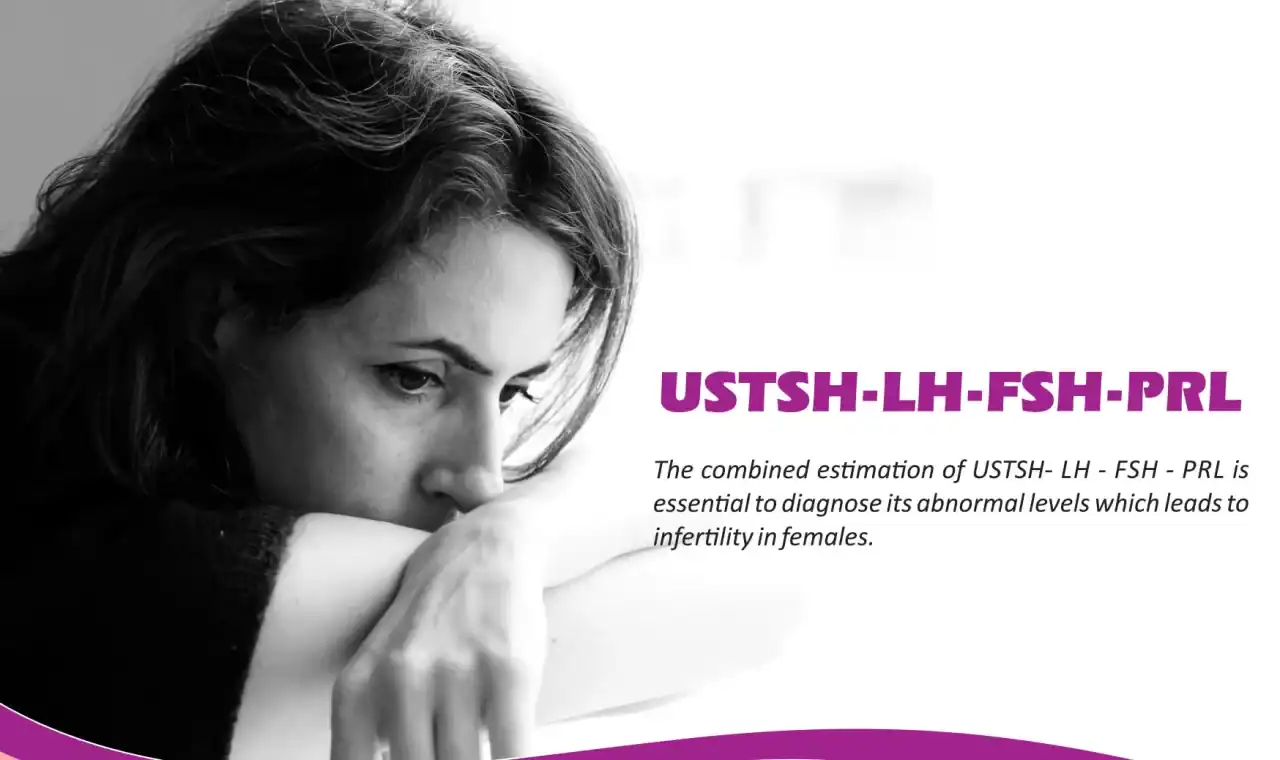
LH, FSH, PRL, and TSH (Ultrasensitive) Test Profile: Basic Hormone Panel for Women
Booking partner: Healthcare Offers. Tests performed by Thyrocare. The report is intended for interpretation by a qualified medical professional. If unexpected abnormalities are observed, you may be advised before initiating treatment.
Test Composition: Basic Female Fertility & Hormone Panel
This profile measures four commonly ordered hormones used to support clinician-led evaluation of thyroid signaling and reproductive hormone patterns. It may be included in fertility workups and menstrual-cycle evaluation, depending on the clinical question and timing.
Key Biomarkers Included (4)
- Follicle Stimulating Hormone (FSH): Used in clinician-led evaluation of ovarian function and cycle patterns, based on timing.
- Luteinising Hormone (LH): Interpreted with cycle day and symptoms; often reviewed alongside FSH in fertility contexts.
- PRL (Prolactin): Ordered when symptoms/history suggest prolactin-related disruption; interpretation depends on context and repeat strategy.
- TSH (Ultrasensitive): Supports evaluation of thyroid signaling, which can be clinically relevant in menstrual and fertility planning.
This panel is commonly used as an initial hormone check when a clinician is evaluating cycle-related concerns or fertility planning.
Related: PRL test details, AMH (Anti-Müllerian Hormone), Advanced Female Hormone Panel & PCOD Profile.
Preparation and timing
- Fasting: Not required.
- Time of day: Morning samples are preferred for consistency.
- Cycle timing: Many clinicians use days 2–5 for LH/FSH comparability; follow your clinician’s plan.
- Medications: Disclose thyroid meds, hormonal therapy, and relevant prescriptions/supplements.
- Clinical History: Inform if you have any known clinical history.
Browse: Women’s health profiles.
Clinical use and limitations
Clinical use (how clinicians commonly use this panel)
- Thyroid signaling check: ultrasensitive TSH helps review thyroid stimulation status in context.
- Cycle and ovulation-related review: LH and FSH are used to interpret ovarian function patterns when timing is clinically planned.
- Prolactin evaluation: PRL is ordered when symptoms/history suggest prolactin-related disruption.
Limitations (what this panel cannot confirm by itself)
- This panel does not diagnose infertility, PCOS/PCOD, thyroid disease, or pituitary disorders on its own.
- Interpretation depends on symptoms, cycle day, medicines, and other investigations; follow a qualified clinician’s plan.
Factors that can affect results
- Cycle day and sampling time: LH/FSH vary across the cycle; morning sampling improves comparability when follow-up is planned.
- Thyroid or hormonal medicines: thyroid medication, hormonal therapy, and fertility medicines can shift values; disclose current dosing.
- Recent pregnancy/postpartum status: can alter PRL and other hormone patterns; share relevant history at booking.
- Acute illness, major stress, or sleep disruption: can influence hormone levels in some clinical contexts.
- Supplements: if you take high-dose supplements (including biotin), inform the team before collection.
For planned comparisons, follow your clinician’s timing instructions rather than repeating tests randomly.
Laboratory methodology
- Technology used: E.C.L.I.A (Electrochemiluminescence Immunoassay)
- Method: Fully Automated Electrochemiluminescence Sandwich Immunoassay
- Sample type: Serum
Electrochemiluminescence immunoassay (ECLIA) is a high-sensitivity automated method widely used in endocrine testing. Results should be interpreted with appropriate clinical correlation.
Understanding reference ranges
Reference ranges represent the values within which approximately 95% of the normal population fall. Values outside this range do not confirm disease by themselves and require clinician-led interpretation.
Laboratory reporting units and ranges may vary between platforms; comparison should be made using the same laboratory method when possible.
Reporting workflow transparency
- SCT: Sample Collection Time
- SRT: Sample Receiving Time at laboratory
- RRT: Report Release Time
These timestamps are recorded in laboratory systems to maintain process transparency and traceability.
Authorship and medical review
Written by:
Hema Mehta Sahoo
Medically reviewed by:
Dr. M A Khan, MBBS, MD Pathology
Medically reviewed: February 27, 2026
Last updated: February 27, 2026
Medical review verifies responsible lab-test framing and safety language; it does not replace clinical diagnosis or treatment.
Sample report (PDF)
View the sample report to understand report layout, units, and reference intervals. Patient identifiers in the sample are masked.
This sample is for format understanding only. Interpretation should be done by a qualified clinician.
Booking procedure (home sample pickup)
Step-by-step
- Select the profile and tap Book on WhatsApp (or call).
- Share: name, age, gender, contact details, address, PIN code, preferred date/time.
- Appointment is confirmed and scheduled.
- Technician visits your home/office to collect the blood sample.
- Pay online during the sample collection.
- Reports are shared within 12 to 24 hours (confirm by area PIN code).
Service-area note
Availability and turnaround time vary by city. Share your PIN code for confirmation.
FAQs — TSH, LH, FSH, PRL panel
Is fasting required?
Fasting is not required for this Basic Hormone Test Panel Female (LH, FSH, PRL, and TSH).
When should women take LH/FSH tests?
Often days 2–5 of the cycle for comparability; follow your clinician’s advice.
How soon are reports available?
Within 12 to 24 hours after collection; timing can vary by city.
What is the closest Thyrocare reference for this profile?
Thyrocare profile reference: ustsh-lh-fsh-prl.
Other relevant tests and profiles
AMH Test
Commonly ordered in fertility contexts. Often bundled with TSH, LH, FSH, and PRL.
PRL Test
Choose this option if you need a single test only.
All Women’s Health Profiles
Browse women-focused panels and profiles, including all hormone and PCOD panels.
Female hormone panel advanced
Broader panel for better screening.