
Thalassemia and Sickle Cell Tests
Compare Hb HPLC, hemoglobin electrophoresis, sickle cell screening, and comprehensive anemia testing by Thyrocare. Prices start at ₹349 with free home sample collection.
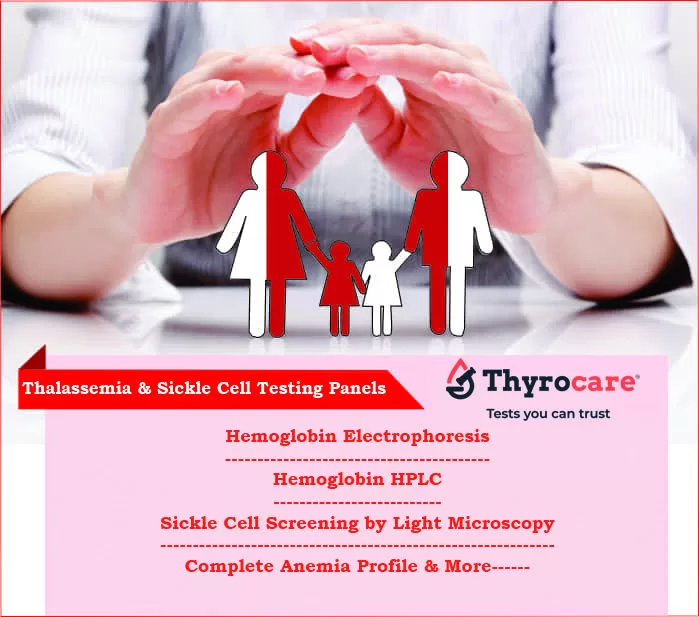
Tests covered: Hb HPLC, hemoglobin electrophoresis, rapid sickle cell or sickling test, sickle cell test through light microscopy, and comprehensive anemia and nutrition testing.
Book Now, Pay During Sample Collection.
Sickle Cell, Thalassemia, Hb HPLC and Hb Electrophoresis Test Prices
| Test/Profile | Methods & What the Test Reports | Offer Price | Discount | Booking |
|---|---|---|---|---|
| Hb HPLC Test | Hemoglobin fractions and detected variants, including Hb A2, Hb C, Hb D, Hb F, and Hb S. | ₹568 | 62% off MRP | Book · Details |
| Hb Electrophoresis Test | Hemoglobin fractions and detected variants, including Hb A, Hb A2, Hb F, Hb C, Hb D, and Hb S; includes an electrophoresis graph | ₹1,199 | 40% off MRP | Book · Details |
| Sickle Cell Test (Sickling Test) | Rapid Hb S screening by solubility method using a sickle cell strip | ₹349 | 50% off MRP | Book · Details |
| Sickle Cell Test through Light Microscopy | Sickle cell screening using solubility and light microscopy methods | ₹2,299 | 50% off MRP | Book · Details |
| Anemia & Nutrition Checkup | Comprehensive panel: hematology indices, hemoglobin variants, iron studies, vitamins, thyroid | ₹4,800 | 50% off MRP | Book · Details |
When Sickle Cell and Thalassemia Tests Are Used
Hb HPLC, hemoglobin electrophoresis, rapid sickling test, and light microscopy-based sickle cell tests serve different screening and hemoglobin analysis purposes. Hb HPLC and hemoglobin electrophoresis can both assess beta thalassemia patterns and detect Hb S associated with sickle cell, along with other hemoglobin variants, from a single blood sample. These tests are commonly used for:
- Premarital and Preconception Screening: To check whether either partner carries a thalassemia or sickle cell trait.
- Unexplained Anemia: To investigate low hemoglobin or microcytic hypochromic red-cell indices that are not fully explained by iron deficiency.
- Sickle Cell Screening: To screen for Hb S or examine hemoglobin fractions and detected variants.
- Follow-up Testing: Hb HPLC or hemoglobin electrophoresis can provide detailed fraction and variant analysis after an abnormal initial screening result.
How Hb HPLC, Hb Electrophoresis and Sickle Cell Tests Differ
Hb HPLC test: what it is, what it reports
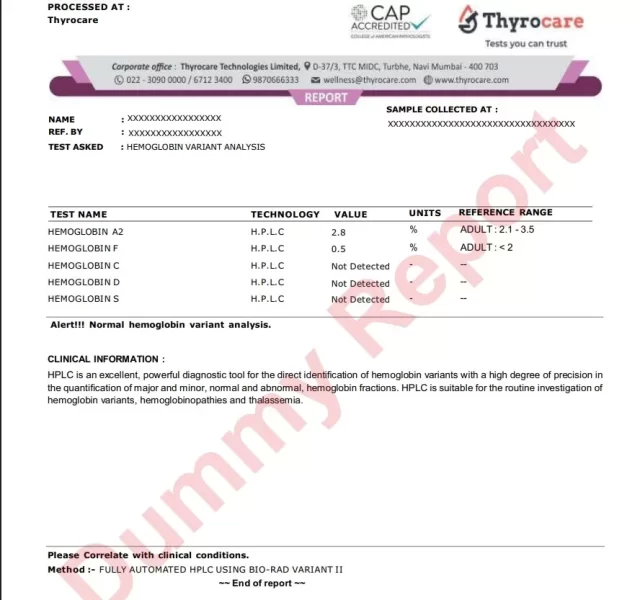
Hb HPLC (High-Performance Liquid Chromatography) is an advanced laboratory method used for hemoglobin variant analysis and beta thalassemia screening. It separates and measures common hemoglobin fractions that can be relevant in suspected thalassemia traits or sickling disorders.
Commonly reported hemoglobin variants include:
- Hb A2
- Hb C
- Hb D
- Hb F
- Hb S
Hb Electrophoresis test: when it’s used
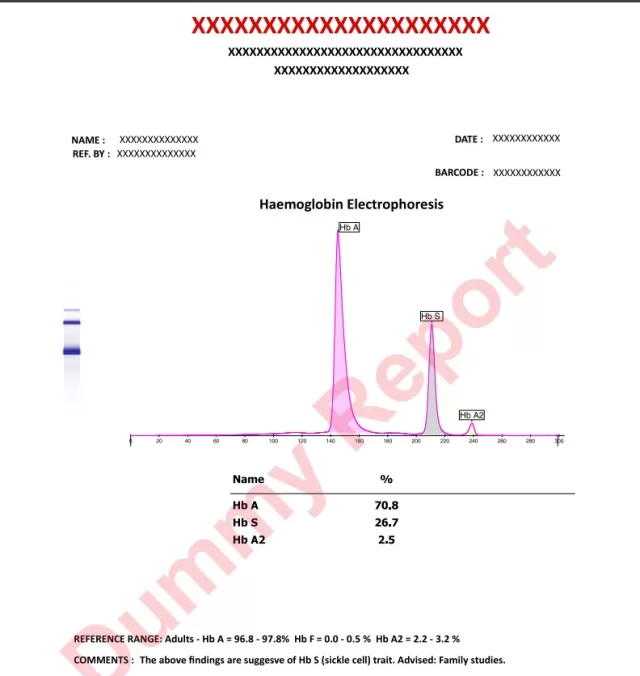
Hemoglobin electrophoresis separates hemoglobin variants according to their movement in an electric field and presents the separation pattern in a graph. It can report the major fractions and variants assessed through Hb HPLC, including Hb A, Hb A2, Hb F, Hb C, Hb D, and Hb S, depending on what is detected in the sample. Non-detected variants are not reported as measured results.
Rapid sickle test: initial screening
The rapid sickle test is designed as an initial screen for Hb S patterns. A positive result must be confirmed by Hb HPLC or Hb Electrophoresis.
Sickle Cell Test through Light Microscopy
The Sickle Cell Test through Light Microscopy uses both solubility and light microscopy methods for sickle cell screening. It is an initial screening test; Hb HPLC or hemoglobin electrophoresis provides detailed information about hemoglobin fractions and detected variants when further analysis is required.
Comprehensive panel option: anemia & nutrition checkup
The Anemia & Nutrition Checkup combines hematology indices, hemoglobin variant analysis, iron studies, vitamin testing, and thyroid tests. It is a comprehensive option when anemia evaluation requires more than a single Hb HPLC, electrophoresis, or sickle cell screening test.
Thyrocare Sample Reports
Hb HPLC sample report image
Hb Electrophoresis sample report image
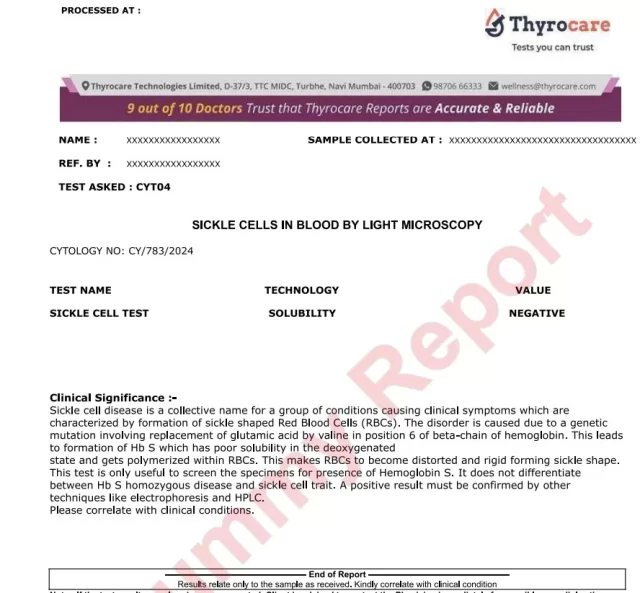
Sickle cell test through light microscopy sample report image
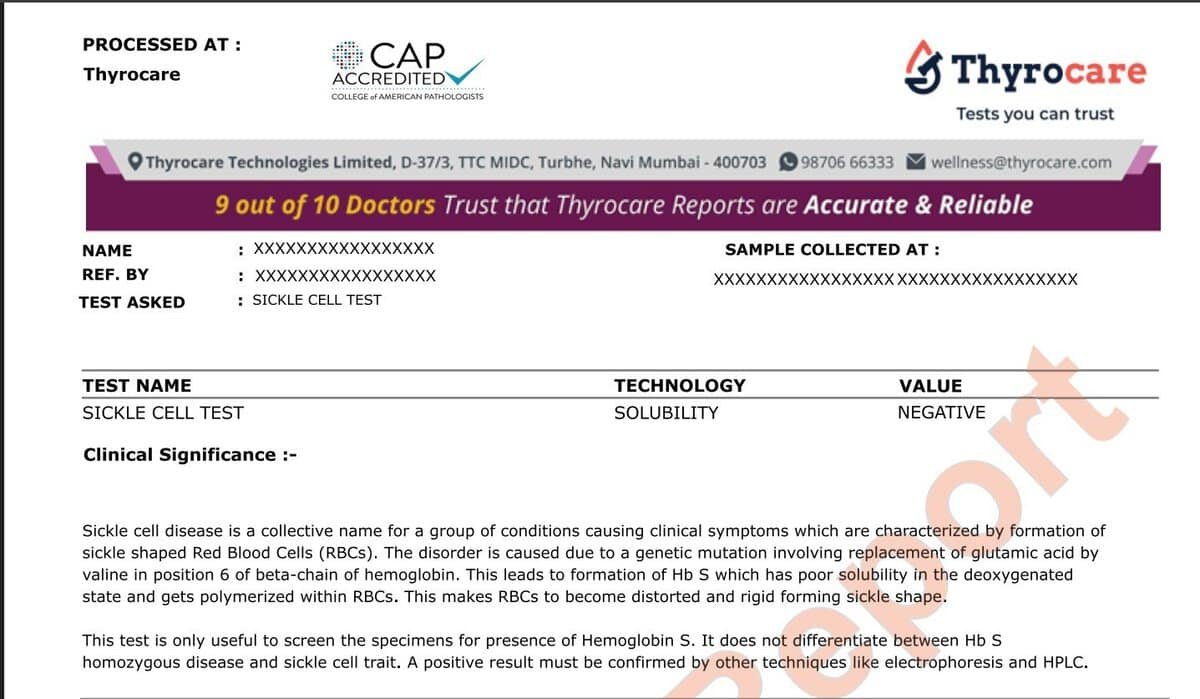
Sickle cell blood test sample report image
Sample Type, Fasting and Reporting Time
- Sample Type: Blood sample collected at your address.
- Fasting: The individual sickle cell, Hb HPLC, and Hb electrophoresis tests do not require fasting. The Anemia & Nutrition Panel requires 10–12 hours of fasting.
- Transfusion History: Recent blood transfusions can significantly alter hemoglobin testing. Please inform your doctor.
- Reporting Time: Reports are delivered through email and WhatsApp within 24–84 hours, depending on the selected test.
Frequently Asked Questions
Which tests are commonly used for thalassemia screening?
Two commonly used lab approaches are hemoglobin electrophoresis and Hb HPLC (hemoglobin variant analysis). A medical professional may choose one or both based on the use case (screening, confirmation, family history) and other blood indices.
What is the difference between Hb HPLC and hemoglobin electrophoresis?
Both Hb HPLC and hemoglobin electrophoresis analyse hemoglobin fractions and can detect beta thalassemia patterns, Hb S, and other hemoglobin variants from a single blood sample. Hb HPLC generally provides higher accuracy in the measurement of hemoglobin fractions because it offers better resolution, reproducibility, and automated quantification. Hemoglobin electrophoresis separates the fractions in an electric field and provides an electrophoresis graph.
How reliable is a rapid solubility sickle cell test report?
A rapid solubility sickle cell test is useful for initial Hb S screening, but it is not reliable enough for a final diagnosis. It cannot quantify Hb S or distinguish sickle cell trait from sickle cell disease. A positive, doubtful, or clinically inconsistent result should be confirmed with Hb HPLC or hemoglobin electrophoresis.
Can a CBC detect anemia?
A CBC/complete hemogram can indicate anemia by reporting hemoglobin and red-cell indices, but it does not establish the cause. Medical professionals often combine CBC with iron studies and/or hemoglobin variant tests when needed.
Can a CBC differentiate iron deficiency anemia from beta thalassemia trait?
A CBC can detect anemia and provide red-cell indices that help differentiate Iron Deficiency Anemia (IDA) from Beta Thalassemia Trait (BTT). A Mentzer Index above 13, RDWI above 220, and RDW-CV above 14 are more likely in IDA. A Mentzer Index below 13, RDWI below 220, and RDW-CV below 14 are more likely in BTT. These indices provide screening clues rather than a final diagnosis. Clinical correlation is advised, and suspected BTT may be confirmed with Hb HPLC and/or hemoglobin electrophoresis.
Does an iron profile diagnose every type of anemia?
No. Iron studies help evaluate iron deficiency patterns; other causes may require different tests (for example, hemoglobin variant analysis or vitamin testing) based on clinical assessment.
Can adults get tested for thalassemia traits?
Yes. Testing can be done at any age, especially when there is family history, unexplained anemia patterns, or for preconception/prenatal counseling pathways advised by a medical professional.
Written by: Hema Mehta Sahoo
Medically reviewed by: Dr. M A Khan, MBBS, MD Pathology
Sources:
Medical News Today,
American Society of Hematology
Last updated: July 13, 2026