
AMH Test at Discounted Price
Book Thyrocare’s Anti-Mullerian Hormone (AMH) test across India as a standalone blood test or bundled with related hormone tests. This blood test helps assess ovarian reserve and supports fertility planning, IVF assessment, and PCOS review.
Book Securely via WhatsApp, Pay During Sample Collection
Anti-Mullerian Hormone (AMH) Test: Quick Facts
| Also Known As | AMH Test, Ovarian Reserve Test, Mullerian Inhibiting Substance (MIS) Test. |
| Starting Price | ₹700 (If bundled with other six related tests) |
| Single Offer Price | ₹1,699 |
| Sample Type | Blood (Serum) |
| Fasting | Not required |
| Testing Lab | Thyrocare |
| Lab Credentials | Regional and zonal processing labs (RPLs and ZPLs) have NABL accreditation; Thyrocare’s central processing lab (CPL) has CAP and NABL accreditation. |
| Clinical Use | Estimating ovarian reserve, supporting PCOS evaluation, and helping doctors plan IVF or fertility treatment. |
| Reporting Time | 12 to 36 hours after sample collection |
| Service Type | Free home sample collection (in 2,500+ PIN code areas across India). |
AMH Test Options & Prices
Thyrocare offers the AMH test as a standalone marker or as part of a comprehensive female hormone profile. Please select the option that matches your clinician’s prescription.
| Profile Name | Tests Included | Offer Price | MRP |
|---|---|---|---|
| AMH Test with Related Hormone Tests | AMH at ₹700 + LH, FSH, PRL, TSH, T3, and T4 at ₹1,299. Total payable amount: ₹1,999. | AMH component: ₹700 Total: ₹1,999 | AMH MRP ₹2,400 |
| AMH (Single Test) | Anti-Mullerian Hormone (AMH) only. | ₹1,699 |
Note: If you have a prescription listing additional hormone tests, share it with our support team via WhatsApp. We will help you select the most appropriate testing profile.
Laboratory Methodology & Process
Thyrocare processes the AMH blood test using fully automated, high-precision Chemiluminescence Immunoassay (CLIA) technology. The standard testing protocol involves:
- A certified phlebotomist collects approximately 3 mL of venous blood from your arm.
- No fasting is required. You can eat, drink, and take the test at any time of the day, regardless of your menstrual cycle phase.
- The blood serum is separated and analyzed using advanced CLIA (Chemiluminescence Immunoassay) technology and One-Step Immunoenzymatic (Sandwich) Assay method for quantitative AMH measurement.
- Strict biological reference intervals are applied based on patient age.
- Digitally verified reports are released within 12 to 36 hours of sample collection.
How to Book Home Collection
- Send a WhatsApp message to +91 70701 77147.
- Specify whether you need the “Single AMH Test” or the full “AMH Profile.”
- Share the beneficiary’s full name, age, gender, exact address with the PIN code, and your preferred time for the blood draw.
- Our support team will verify Thyrocare’s service availability for your PIN code and confirm your booking slot within a few minutes.
- A technician will visit your home to safely collect the sample.
Sample Report: AMH Blood Test
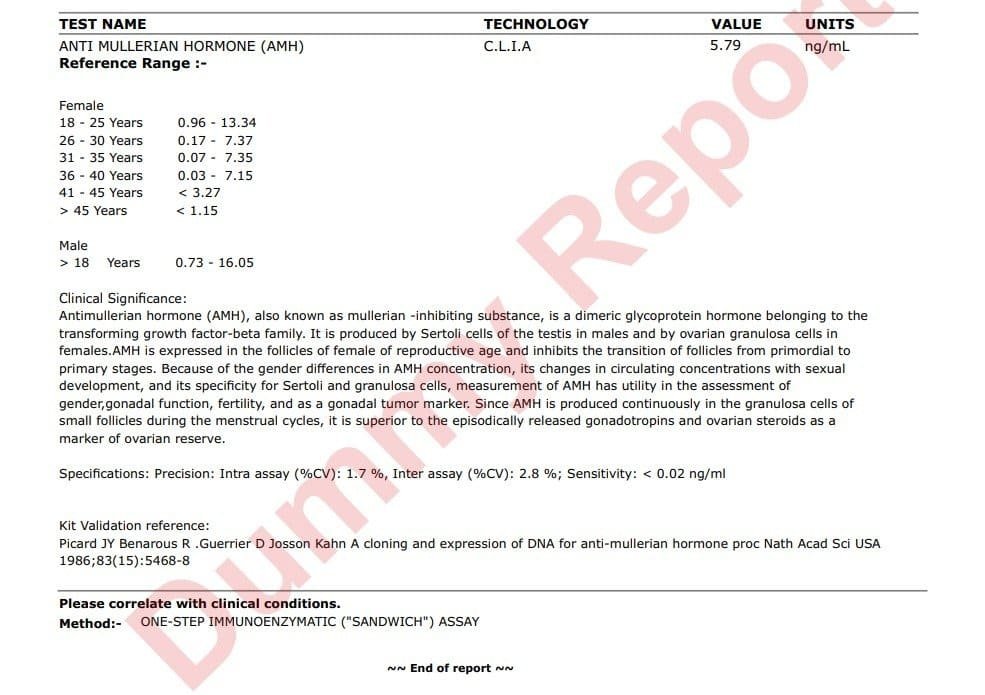
Review the format preview below to understand how the Anti-Mullerian Hormone concentration is reported against age-specific biological reference intervals established by the laboratory.
What is Anti-Mullerian Hormone (AMH)?
Anti-Mullerian Hormone (AMH) is a protein hormone produced by the granulosa cells inside the ovarian follicles (the tiny sacs in the ovaries that hold eggs). In women of reproductive age, the level of AMH in the blood serves as a reliable biomarker for estimating the ovarian reserve, the remaining ovarian follicle pool.
Unlike other reproductive hormones such as FSH (Follicle Stimulating Hormone) or LH (Luteinizing Hormone), AMH levels do not fluctuate significantly during the menstrual cycle. This stability makes the AMH blood test a convenient and accurate diagnostic tool that can be performed on any day of the month to assess a woman’s fertility potential.
Clinical Significance of AMH Levels
Gynecologists and fertility specialists use AMH levels to evaluate reproductive health, plan IVF (In Vitro Fertilization) treatments, and diagnose underlying endocrine disorders.
| AMH Level Indication | Clinical Association & Diagnostic Value |
|---|---|
| High AMH Levels | Often indicates the presence of a large number of small follicles. Abnormally high levels are frequently associated with Polycystic Ovary Syndrome (PCOS). High AMH may alert doctors to consider the risk of Ovarian Hyperstimulation Syndrome (OHSS) during IVF planning. |
| Normal AMH Levels | Suggest an age-appropriate ovarian reserve and may help doctors estimate the likely response to fertility medicines. |
| Low AMH Levels | Can indicate Diminished Ovarian Reserve (DOR), especially when interpreted with age, ultrasound findings, and other hormone results. While this means the remaining egg count is lower than expected for a given age, it does not necessarily mean natural pregnancy is impossible. It helps doctors tailor more aggressive IVF stimulation protocols. |
| Very Low / Undetectable | Typically seen in women approaching menopause, those who have gone through menopause, or younger women experiencing Premature Ovarian Failure (POF). |
Important Clinical Limitation: AMH reflects ovarian reserve, not egg quality. A low AMH level does not absolutely predict infertility, nor does a normal AMH guarantee a successful pregnancy. Age remains the primary predictor of egg quality.
FAQs: Anti-Mullerian Hormone (AMH) Test
What exactly does the AMH test measure?
Does the AMH test determine if I can get pregnant?
When is the best time during my menstrual cycle to take the AMH test?
Why is AMH tested in patients suspected of having PCOS?
Why do gynecologists advise other hormone tests along with an AMH test?
Which Thyrocare panels include AMH test?
Does a full body checkup package for women include AMH test?
References: ASRM (Ovarian Reserve Testing) • MedlinePlus (AMH Test) • Cleveland Clinic (AMH Overview)
Note: This information is strictly for educational and test booking purposes. AMH is just one marker in evaluating reproductive health. Always consult a gynecologist or fertility specialist (REI) to interpret AMH results in conjunction with ultrasound findings, age, and clinical history.
Written by: Hema Mehta Sahoo
Medically reviewed by: Dr. M A Khan, MBBS, MD Pathology
Last updated: May 17, 2026